
 | Antoine Henri Becquerel, Pierre Curie, and Marie Curie 1903 Winners |
Pierre and Marie Curie: "[for] their joint researches on the radiation phenomena discovered by Professor Henri Becquerel"


Biography : Becquerel
Antoine Henri Becquerel was born in Paris on December 15, 1852, a member of a distinguished family of scholars and scientists. His father, Alexander Edmond Becquerel, was a Professor of Applied Physics and had done research on solar radiation and on phosphorescence, while his grandfather, Antoine César, had been a Fellow of the Royal Society and the inventor of an electrolytic method for extracting metals from their ores. He entered the Polytechnic in 1872, then the government department of Ponts-et-Chaussées in 1874, becoming ingénieur in 1877 and being promoted to ingénieur-en-chef in 1894. In 1888 he acquired the degree of docteur-ès-sciences. From 1878 he had held an appointment as an Assistant at the Museum of Natural History, taking over from his father in the Chair of Applied Physics at the Conservatoire des Arts et Metiers. In 1892 he was appointed Professor of Applied Physics in the Department of Natural History at the Paris Museum. He became a Professor at the Polytechnic in 1895. [[ continue reading ]]
Biography : Pierre Curie
Pierre Curie was born in Paris, where his father was a general medical practitioner, on May 15, 1859. He received his early education at home before entering the Faculty of Sciences at the Sorbonne. He gained his Licenciateship in Physics in 1878 and continued as a demonstrator in the physics laboratory until 1882 when he was placed in charge of all practical work in the Physics and Industrial Chemistry Schools. In 1895 he obtained his Doctor of Science degree and was appointed Professor of Physics. He was promoted to Professor in the Faculty of Sciences in 1900, and in 1904 he became Titular Professor.
In his early studies on crystallography, together with his brother Jacques, Curie discovered piezoelectric effects. Later, he advanced theories of symmetry with regard to certain physical phenomena and turned his attention to magnetism. He showed that the magnetic properties of a given substance change at a certain temperature - this temperature is now known as the Curie point. To assist in his experiments he constructed several delicate pieces of apparatus - balances, electrometers, piezoelectric crystals, etc.[[ continue reading ]]
Biography : Marie Curie
Marie Curie, née Maria Sklodowska, was born in Warsaw on November 7, 1867, the daughter of a secondary-school teacher. She received a general education in local schools and some scientific training from her father. She became involved in a students' revolutionary organization and found it prudent to leave Warsaw, then in the part of Poland dominated by Russia, for Cracow, which at that time was under Austrian rule. In 1891, she went to Paris to continue her studies at the Sorbonne where she obtained Licenciateships in Physics and the Mathematical Sciences. She met Pierre Curie, Professor in the School of Physics in 1894 and in the following year they were married. She succeeded her husband as Head of the Physics Laboratory at the Sorbonne, gained her Doctor of Science degree in 1903, and following the tragic death of Pierre Curie in 1906, she took his place as Professor of General Physics in the Faculty of Sciences, the first time a woman had held this position. She was also appointed Director of the Curie Laboratory in the Radium Institute of the University of Paris, founded in 1914.[[ continue reading ]]
Legacy : Nuclear Power

Nuclear physics gives us chances to design some mechanisms in atomic scale. The famous one is 'nuclear fission reaction'. This reaction is mainly used in nuclear power plants which are the big sources of electricity in many countries all around the world.
Legacy : Carbon Dating
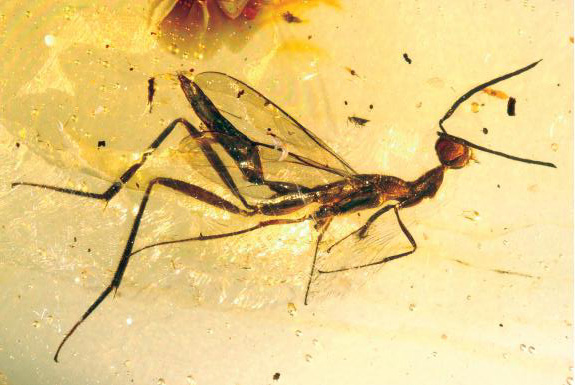
Leptofoenus pittfieldae trapped in Dominican amber, from 20 to 16 million years ago. The age can be determined by using carbon dating method.
Carbon has two stable, nonradioactive isotopes: carbon-12 (12C), and carbon-13 (13C). In addition, there are trace amounts of the unstable isotope carbon-14 (14C) on Earth. Carbon-14 has a relatively short half-life of 5,730 years, meaning that the amount of carbon-14 in a sample is halved over the course of 5,730 years due to radioactive decay. Carbon-14 would have long ago vanished from Earth were it not for the unremitting cosmic ray flux interactions with the Earth's atmosphere, which create more of the isotope. The neutrons resulting from the cosmic ray interactions participate in the following nuclear reaction on the atoms of nitrogen molecules (N2) in the atmosphere:

Plants take up atmospheric carbon dioxide by photosynthesis, and are ingested by animals, so every living thing is constantly exchanging carbon-14 with its environment as long as it lives. Once it dies, however, this exchange stops, and the amount of carbon-14 gradually decreases through radioactive beta decay with a half-life of 5,730 ± 40 years.
The number of carbon-14 atom can be determined as a function of time

Thus, if we know the amount of C-14 at the present time and the original amount, we can guess the age of any object in the world.
To know more check out these URLs :
http://en.wikipedia.org/wiki/Nuclear_fission
http://en.wikipedia.org/wiki/Nuclear_power_plant
http://en.wikipedia.org/wiki/Radiocarbon_dating
http://hyperphysics.phy-astr.gsu.edu/hbase/nuclear/cardat.html
No comments:
Post a Comment